
Madison County Court Records After a Jail Arrest
A jail arrest is the start of a case, not the end of one. When deputies book someone into the Madison County Jail, the roster lists the arrest charges, the booking time, and a bond. That booking entry is not the court record. The court record opens later. The State Attorney for the Third Judicial Circuit reviews the arrest and decides what charges, if any, to file. Once those charges are filed, a case number is assigned and the court record begins.
It helps to keep two record sets apart. The booking side covers custody. To see who is in the jail right now, the booking number, and the bond, check the jail inmate records, and for booking photos see the jail roster mugshots. The court side covers the charges the prosecutor filed and what happened to them. Booking charges can change, drop, or grow once a prosecutor takes the file.
The pathway is short to state. Arrest leads to jail booking. Booking leads to first appearance within 24 hours. The judge there advises the charges and sets bond. The State Attorney then files the formal charges. The clerk opens the case, and the court record exists from there.
How to Find Madison County Court Records After an Arrest
Formal charges after an arrest show up in the clerk's court case system, not on the jail roster. The Madison County Clerk of Court, Billy Washington, links court records search to the Civitek Online Court Records Search, known as OCRS, for Madison County. The entry point lets you choose an access tier before you search. The public tier gives anonymous access to court records. Attorney, Registered User, and Party Access tiers each need a user id and password and serve people tied to a case. Most people use the public tier to look up a case by name.
To search the court record for a case that followed an arrest, work through the portal step by step.
- Open the Madison County Civitek OCRS court records search and choose the Public access option.
- Search by last name and first name, or by business name, and narrow the result with a date of birth or a case-filed date range.
- Open the matching case and read the charge list the State Attorney filed.
- Check each charge's code, level, and current status, then review the hearings and any disposition.
The Madison Clerk's OCRS access page is where the court record search begins after an arrest.
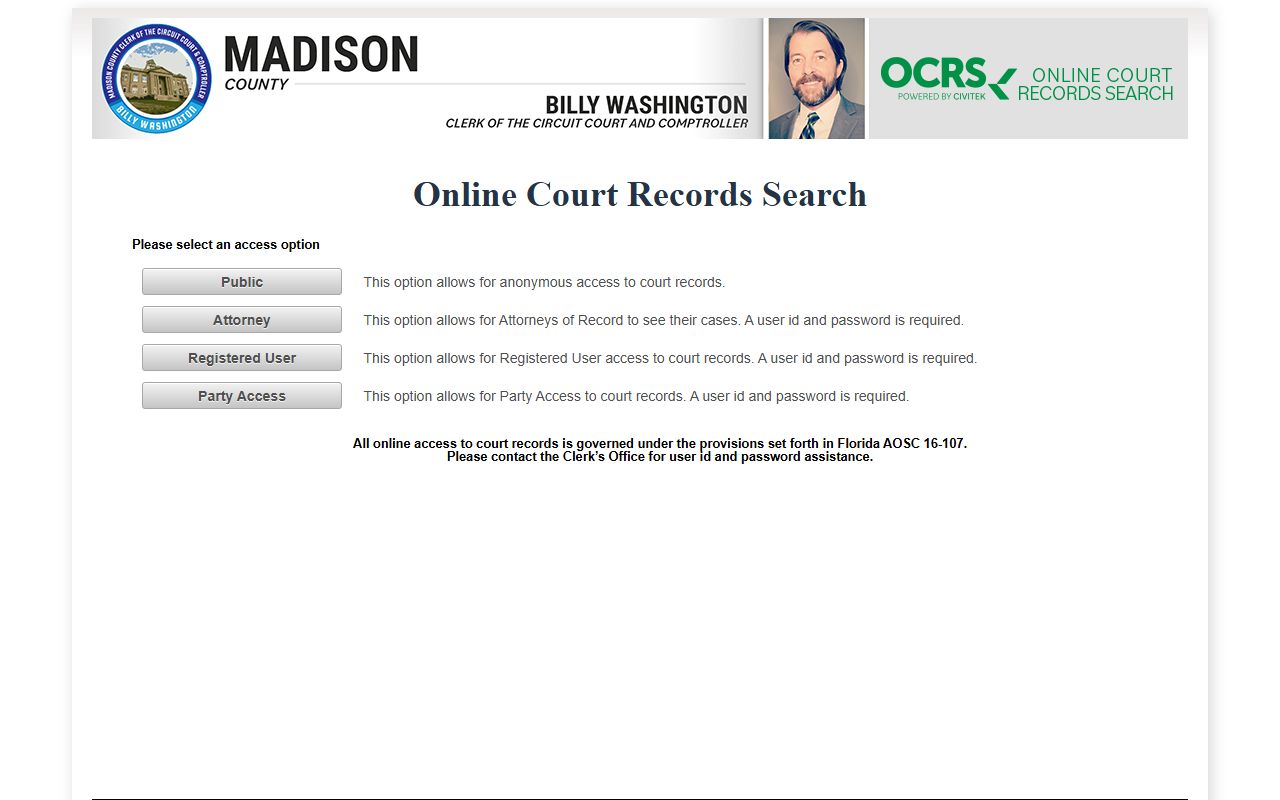
The screen shown above is the access-tier chooser; most arrest-related lookups go through the Public link. The OCRS disclaimer states the data is provided for informational purposes and is not the authoritative public record or a legal document. Online access is governed by Florida administrative order AOSC 16-107. For a certified copy of any court record, request it from the Clerk's office rather than relying on the online view.
Note: OCRS is informational only, so a certified court record after an arrest must come from the Madison County Clerk, not from the public online search screen.
Court Type Filters in the Madison Records Search
The OCRS case search lets you narrow by court type. After an arrest, the criminal court types matter most. The portal uses two-letter codes, and a few of them cover the charges that follow a booking. Picking the right code keeps a name search from returning unrelated civil or family files.
| Search Field | Type | Notes |
|---|---|---|
| Last Name | Text | Required for a person-name search after an arrest |
| Business Name | Text | Used instead of a person name |
| First Name / MI | Text | Narrows a person search |
| Date Case Filed (from / to) | Date range | Filed-date window |
| SSN | Text | Sensitive; access may be restricted |
| DOB | Date | Date of birth to confirm identity |
| Court Type | Checkboxes | AP, CA, CC, CO, CT, DR, CF, GA, MM, MO, IN, CP, SC, TR |
Of those court-type codes, four point to charges that follow an arrest. CF marks a felony case. MM marks a misdemeanor case. CT and TR cover criminal traffic matters. CO covers county ordinance violations. If you do not know the level of the charge, leave the court-type boxes unchecked and let the name search return every case for that person, then read the case labels.
How Charges Get Filed After an Arrest: Complaint, Information, and Indictment
The court charge record starts with a charging document. Booking happens first at the jail. Then a prosecutor or a grand jury files the paper that names the formal charges and opens the case. Florida uses three main charging documents, and which one appears tells you something about the level of the offense.
| Complaint | Information | Indictment | |
|---|---|---|---|
| Filed By | Officer / Prosecutor | State Attorney | Grand Jury |
| Common For | Some misdemeanors | Many felonies | Serious felonies |
| Starts | The case | The case | The case |
A complaint can begin some criminal matters and rests on a sworn account of the facts. An information is the document a prosecutor files to bring most felony and many other charges; it is the State Attorney's formal accusation. An indictment comes from a grand jury and is used for the most serious felonies. In Madison County the charging choice belongs to State Attorney John F. Durrett's office. Because the prosecutor decides what to file, the jail booking charge should never be read as the final filed charge.
Charge Status in Madison County Court Records
Charges move as a case goes forward. A charge can be amended, reduced, added, dropped, or dismissed, and the court record tracks each change. The status you see in OCRS is the current state of that charge, which can differ from the booking charge the jail listed on the day of the arrest. The terms below show up often in criminal case files.
| Status | What It Means |
|---|---|
| Pending | The charge is filed but not yet resolved; the case is still moving through the court. |
| Amended / Reduced | The charge was changed from the original booking or filed charge, often to a lower level. |
| Dismissed | The charge is no longer being pursued and the court has dropped it. |
| Nolle Prosequi | A Latin term meaning the prosecutor has chosen not to pursue the charge; it ends that count. |
Booking charges and filed charges are not the same thing. The roster shows what a deputy booked at intake. The court record shows what the prosecutor actually filed and how each count stands now. A person can be booked on one charge and never face it in court. Always read the court status, not the booking sheet, to learn where a charge truly stands.
Note: A booking charge on the jail roster is an arrest charge, so check the court record for the filed charge and its current status before drawing any conclusion.
Bond and Release After a Madison County Arrest
Bond decides whether a person waits for trial in or out of custody. Under the local first-appearance rule, a person who does not bond out sees a judge within the first 24 hours of the arrest. The judge advises the charges and sets the bond amount. After bond is set, the inmate gets a reasonable chance to call a bondsman or family. The jail roster shows a total bond and a per-charge bond column, so the booking side and the court side both touch bond.
The Third Judicial Circuit sets a uniform bond schedule. Administrative Order 2026-001, dated January 7, 2026, is the current schedule for Madison County criminal proceedings, and it replaced AO 2025-002. The schedule applies before the next first appearance. It does not bind the judge at first appearance or at a later bail hearing, and it does not force police or jail staff to release anyone before first appearance.
Some charges carry no pre-first-appearance release at all. Those categories include capital, life, and first or second degree felonies, homicide, domestic violence, stalking, robbery, burglary, carjacking, a firearm by a felon or an injunction subject, sex offenses and child pornography, elder or disabled abuse, child abuse, arson and riot, escape and tampering, gang offenses, trafficking, racketeering, failure to appear while on bail, and dangerous crimes under F.S. 907.041. For charges that the schedule does cover, set amounts apply.
The Third Circuit's 2026 uniform bond schedule order lists the dollar figures in plain rows.
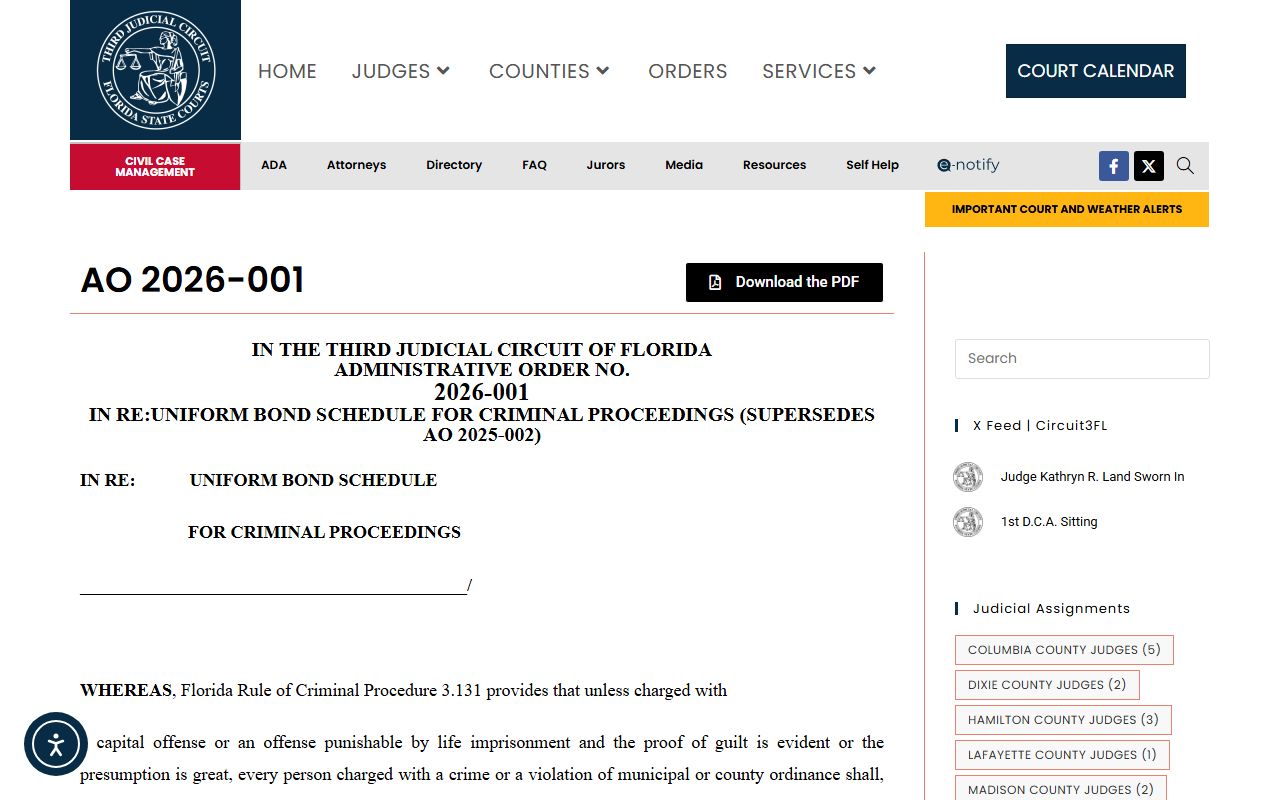
The order shown above sets a $10,000 bond for a third-degree felony with force or threat and $5,000 for one without force. A first-degree misdemeanor or ordinance violation with force is $2,500, while one without force that is not a DUI or BUI is $1,000. A second-degree misdemeanor is $1,000. DUI and BUI amounts run from $2,000 for a first offense to $5,000 for a first-degree misdemeanor DUI.
| Bond Type | How It Works |
|---|---|
| Cash Bond | The full bond is paid in cash to secure release and is held by the court until the case ends. |
| Surety Bond | A licensed bondsman posts the bond for a fee, usually a set percentage of the amount. |
| PR / Own Recognizance | Release on a written promise to appear, with no money posted up front. PR means personal recognizance. |
| No-Bond Hold | No bond is allowed, or a hold for another agency keeps the person in custody even if local bond is met. |
A hold, sometimes called a detainer, is a request from another agency to keep someone in custody. If a Madison County inmate has a hold from another county, a probation matter, or a federal agency, posting the local bond may not bring release.
Warrants That Lead to a Madison County Arrest
Many arrests start with a warrant. The Madison County Sheriff's Office warrants division processes and serves warrants that come from courts and government agencies. When a warrant is served, the person is booked, and the booking may then appear on the jail roster. The court record may show the underlying event, such as a failure to appear or a bond revocation, that the roster alone does not spell out.
The sheriff's warrants page lists the order types the division handles.
- Bench Warrants and Failure to Appear orders
- Orders of Arrest and Orders to take into custody
- Violations of Probation and Violations of Community Control
- Capias, which is a court order directing an arrest
- Order of Contempt, Orders to revoke bonds, Rule to Show Cause, and Pickup Commitment
Madison County does not publish an online active-warrant search, a warrant roster, or a most-wanted page. To check on a warrant, contact Tammy Tuten, the Warrants and Records Clerk, at 850-253-3345. The sheriff's main line is 850-973-4151, and warrants staff work Monday through Friday, 8 a.m. to 5 p.m., except holidays. The clerk's court records can also show bench-warrant, capias, and failure-to-appear entries tied to a case.
The Madison County Sheriff's warrants page describes the categories the division serves.
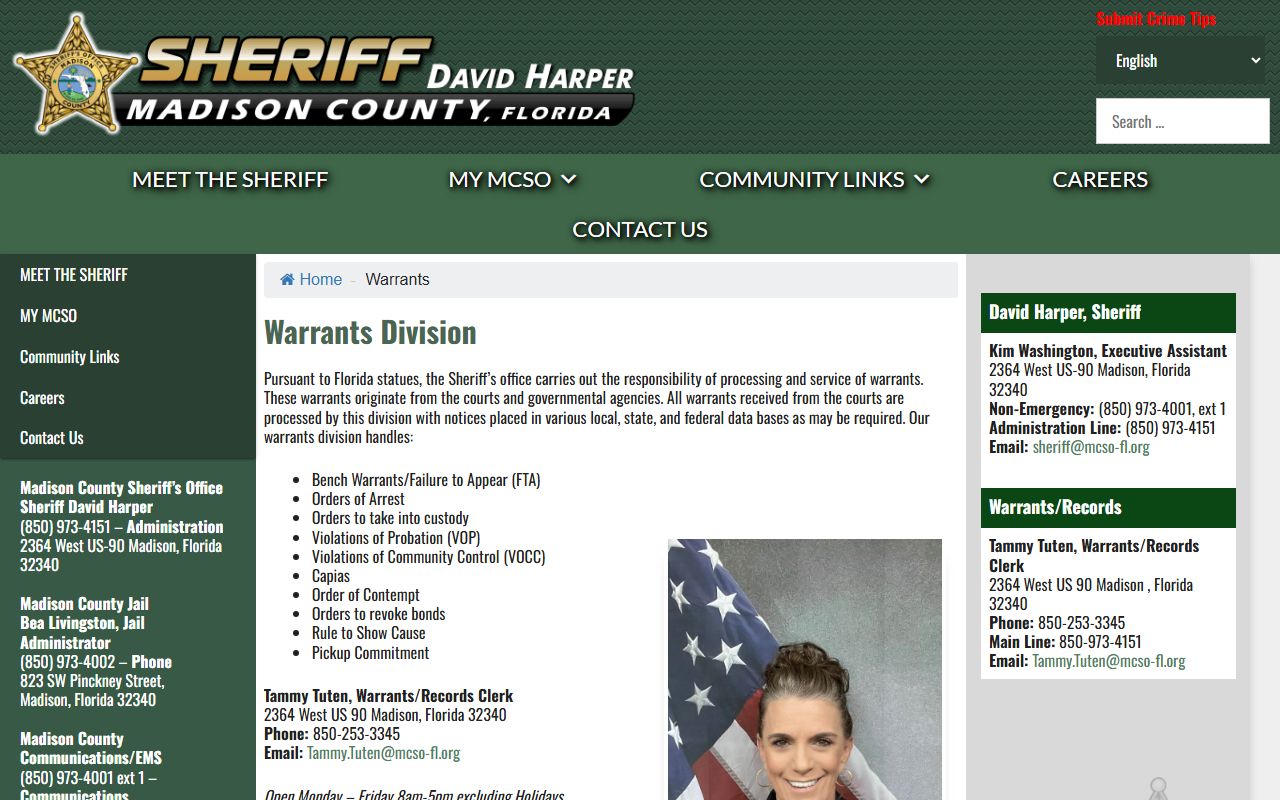
The page shown above confirms there is no public warrant lookup, so the named clerk and direct phone line are the real route to ask about a warrant before it leads to an arrest and a court record.
Charges vs. Convictions
Being arrested and charged is not the same as being convicted. A charge is an accusation. A conviction is the result after a plea or a verdict. The court record shows both stages, and a case can sit at the charge stage for months before any result. Reading a charge as if it were a conviction is a common and costly mistake.
| Charge | Conviction | |
|---|---|---|
| Stage | Accusation | Verdict or plea |
| Burden of Proof | Probable cause | Beyond a reasonable doubt |
| Public Record | Yes | Yes |
Both a charge and a conviction are public court records in Florida. The difference is what each one means. A charge says the State Attorney filed an accusation that rests on probable cause. A conviction says the case ended with proof beyond a reasonable doubt or a plea. A charge that ends in a dismissal or a nolle prosequi never becomes a conviction at all.
Sealed vs. Expunged Court Records After an Arrest
An arrest record and the court record that follows can sometimes be sealed or expunged. The two are not the same. A sealed record is hidden from public view but still exists. An expunged record is destroyed or treated as if it never happened. In Florida the route involves a court process and a public-records framework under Chapter 119, including F.S. 119.01 and F.S. 119.07, which make most records open unless an exemption applies.
| Sealed | Expunged | |
|---|---|---|
| Visibility | Hidden from public view | Destroyed or treated as never existed |
| Law Enforcement | Limited access remains | Very limited access |
| Eligibility | Set by Florida law; verify with the Clerk/court | Set by Florida law; verify with the Clerk/court |
Eligibility for sealing or expunction is set by Florida law and decided by the court, not by any single office. The standards turn on the charge, the disposition, and a person's prior record. To learn whether a Madison County arrest or court record qualifies, ask the Clerk's office or the court, since they handle the petition and the order. A records request under Chapter 119 lets you see what is public now, while a sealing or expunction order changes what stays public going forward.
Public Records From the Clerk, Sheriff, and State Attorney
Three offices hold the pieces of a Madison County arrest-to-court record, and each has its own request channel. The Clerk keeps the court case file. The Sheriff keeps the arrest and booking records. The State Attorney keeps the charging and prosecution records. Florida's public-records law, F.S. 119.01 and F.S. 119.07, opens these to inspection and lets each office charge statutory fees for copies and certification.
For the authoritative court record after an arrest, go to the Clerk.
The Third Judicial Circuit State Attorney's office handles charging and prosecution records. It says public-records requests need not be written and may be anonymous, though fees may apply and must be paid before processing. The public-records custodian is Dana Brady-Giddens at the Live Oak office, 386-362-2320. For booking and arrest reports the Sheriff's public-records channel applies, with requests by phone or email or mailed to the Public Records Custodian at 2364 West US 90, Madison, FL 32340.
Background Check Considerations
Court records after an arrest are public, but using them for screening is its own subject. A casual lookup to read a case is not the same as a regulated background check. When a record is used to decide credit, employment, housing, insurance, or tenant screening, the federal Fair Credit Reporting Act sets rules a consumer reporting agency must follow. Pulling a court case in OCRS to satisfy curiosity carries no such duty, but it also carries no guarantee that what you see is current or complete.
Important: This is not a consumer reporting agency under the FCRA, and nothing here may be used to decide credit, employment, housing, insurance, or tenant screening.
Restricted Court Records After an Arrest in Madison County
Not every record tied to an arrest is open to the public. Juvenile cases carry strong limits, and a juvenile arrest record is generally not searchable the way an adult case is. Sealed charges drop out of the public view by court order. Some sensitive fields, such as a Social Security number, are restricted within OCRS even on an otherwise public case. An ongoing investigation can also keep certain records closed for a time.
When a record is restricted, the path forward is the originating office. The Clerk can confirm whether a court file is sealed or exempt. The Sheriff can explain whether an arrest report is held back for an active case. The State Attorney can speak to charging records under Chapter 119. Online access through OCRS follows AOSC 16-107, so the public tier shows less than what a party or attorney to the case can see. For anything the online search will not return, a direct records request to the right office is the next step.